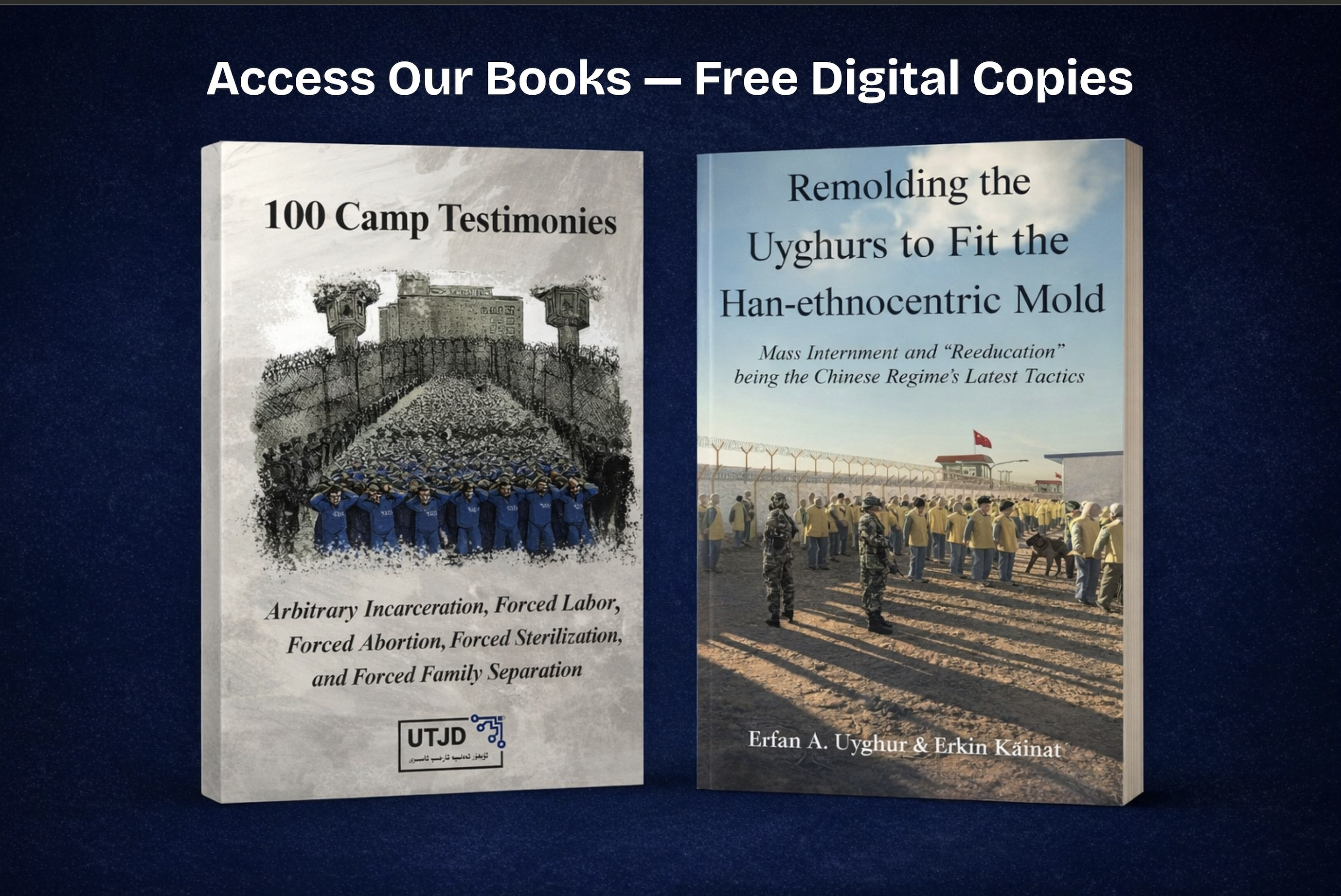
We are pleased to announce that the Uyghur Transitional Justice Database (UTJD) has made its key publications freely available for digital download. This step reflects our commitment to ensuring open access to rigorous research documenting human rights violations against Uyghurs and other Turkic peoples in East Turkistan. By making these works freely accessible, we aim to support education, research, advocacy, and accountability efforts.
100 Camp Testimonies: Arbitrary Incarceration, Forced Labor, Forced Abortion/Sterilization, and Forced Family Separation
100 Camp Testimonies is a crucial historical document that contributes to the understanding of the tragic and opprobrious failure of the Chinese regime in East Turkistan (aka. Xinjiang). A representative set of 100 pertinent testimonies accounts for a range of human rights violations that Uyghurs and other Turkic peoples are subjected to: arbitrary incarceration, forced labor, forced abortion/sterilization, and forced family separation.
Remolding the Uyghurs to Fit the Han-ethnocentric Mold: Mass Internment and “Reeducation” being the Chinese Regime’s Latest Tactics
This book aims to contribute, in the context of (settler) colonialism as well as China’s nation-building, to understanding how the Chinese regime’s mass internment of Uyghurs and other Turkic peoples in East Turkistan, the most oppressive securitization efforts to date to preemptively punish and persecute the whole Turkic Muslim populations, is meant to speed up the remolding process and impose the homogeneous national identity known as Zhonghua Minzu (the Chinese race) on all. Our own research on the camp system presents the spatiotemporal changes of the identified various types of internment sites as well as the statistical data on how many of them were suspected of using forced labor.
Below you will find a step-by-step guide on how to get your digital copy.

By reading and sharing our books, you help preserve evidence, and contribute to ongoing efforts toward truth, accountability, and justice.
If you would like to support our work, there are many ways to get involved — including sharing our materials, volunteering, or donating to support research and translations.