
October 26–30, 2026 | Washington, D.C.
From October 26 to 30, the Uyghur Transitional Justice Database (UTJD) participated in a series of important discussions, public events, and strategic meetings in Washington, D.C., bringing together human rights advocates, researchers, legal experts, policymakers, and civil society organizations to address the ongoing human rights crisis facing Uyghurs and other Turkic peoples in East Turkistan.
Throughout the week, UTJD contributed to discussions on China’s growing global influence, the limitations of existing international accountability mechanisms, the role of technology and artificial intelligence in human rights documentation, and the importance of preserving Uyghur history and survivor testimony.
The visit also provided an opportunity to strengthen relationships with international organizations and explore future cooperation in research, documentation, advocacy, and transitional justice.
October 26 | China’s Growing Global Influence and the Uyghur Question: Human Rights, Geopolitics, and Technology
The week began with an important panel discussion at American University Washington College of Law (AUWCL), organized by the Academy on Human Rights and Humanitarian Law.
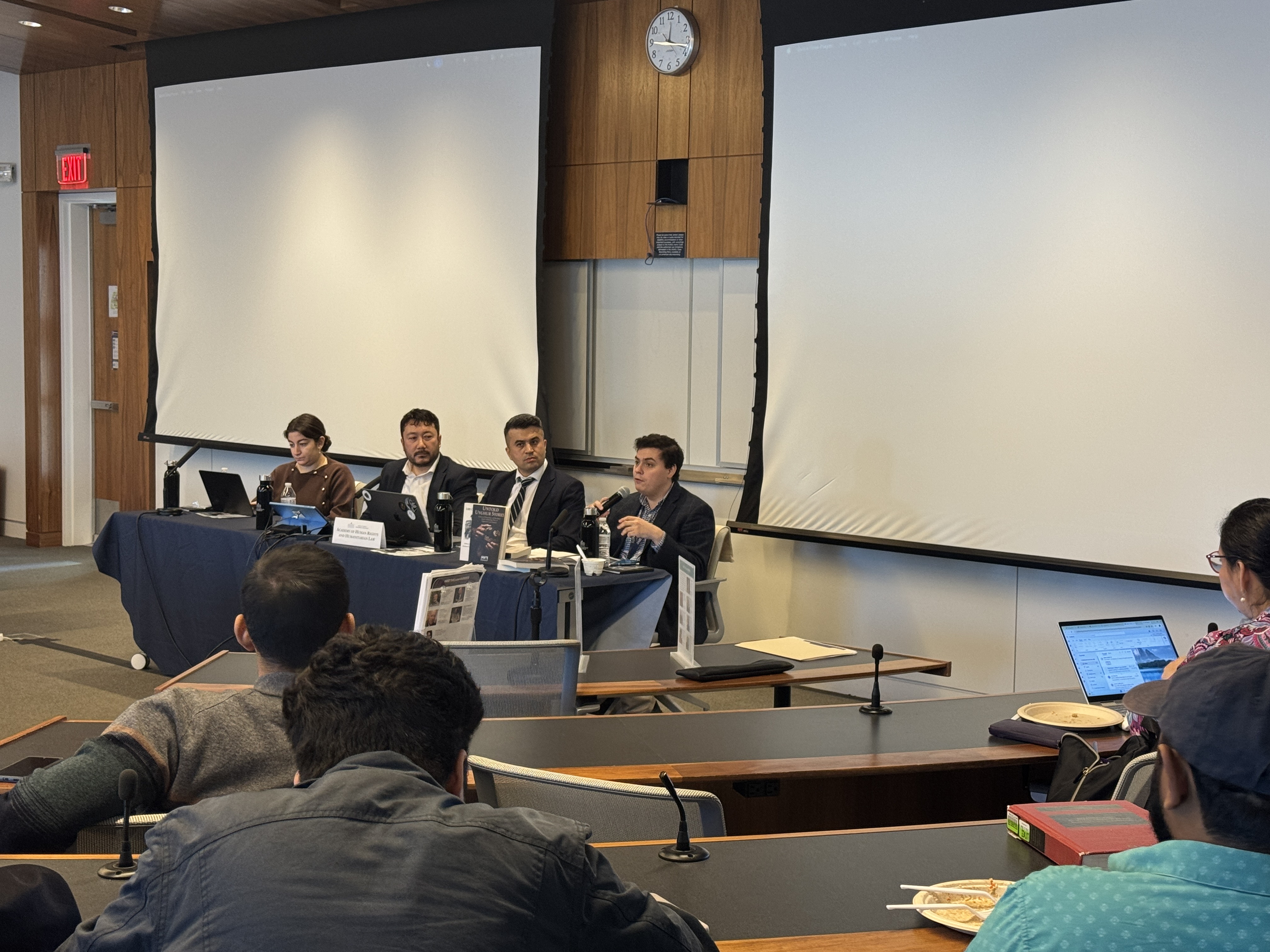
Titled “China’s Growing Global Influence and the Uyghur Question: Human Rights, Geopolitics, and Technology,” the event examined the international implications of China’s expanding political and economic influence and its intersection with human rights concerns in East Turkistan.
The discussion addressed allegations of mass detention, forced labor, and restrictions on Uyghur cultural and religious freedoms. Panelists also explored how geopolitical interests, international trade relationships, and emerging technologies intersect with efforts to document human rights violations and advance accountability.
The limitations of international justice mechanisms
An important part of the discussion focused on the limitations of existing international legal mechanisms in addressing serious human rights violations when the state concerned is a powerful country such as China.
In particular, the discussion examined the jurisdictional obstacles facing efforts to bring allegations against Chinese officials before the International Criminal Court (ICC). China is not a party to the Rome Statute, and the ICC’s territorial and personal jurisdiction requirements create significant obstacles when alleged crimes are committed entirely within China by Chinese nationals. A referral by the UN Security Council represents another possible route, although China’s permanent membership and veto power create an additional political obstacle.
Similar challenges arise in proceedings before the International Court of Justice (ICJ), where jurisdiction generally depends on the consent of states.
These limitations illustrate a broader problem within the international justice system: even when credible evidence of serious international crimes exists, political considerations, jurisdictional restrictions, and the absence of effective enforcement mechanisms can prevent meaningful accountability.
The discussion also highlighted the significance of the Uyghur Tribunal, an independent people’s tribunal established in 2020 under the chairmanship of Sir Geoffrey Nice KC.
In circumstances where existing international judicial mechanisms faced substantial jurisdictional and political obstacles, the Uyghur Tribunal provided an independent forum to examine evidence concerning alleged international crimes against Uyghurs and other Turkic peoples.
The Tribunal assessed the situation in East Turkistan under applicable international law, including the legal frameworks governing genocide and crimes against humanity. It heard witness testimony, examined documentary evidence, and applied international legal standards, including a beyond-reasonable-doubt standard of proof.
Although the Uyghur Tribunal was not an official international court and its findings were not legally binding, it demonstrated how independent evidence-based investigations can contribute to documenting atrocities, preserving evidence, and strengthening the broader pursuit of accountability.
Strengthening international law and accountability
The conversation further raised the question of whether existing international legal frameworks and enforcement mechanisms are sufficient to address serious violations committed by powerful states.
While international law establishes important obligations, the mechanisms available to ensure compliance and impose meaningful consequences remain limited in certain circumstances.
Examples discussed included the international accountability challenges surrounding China’s commitments under the Sino-British Joint Declaration concerning Hong Kong, as well as concerns about the absence of enforceable human rights and labour rights provisions in the China-Australia Free Trade Agreement.
These examples highlight a broader challenge: international agreements and economic relationships do not always provide effective mechanisms for addressing human rights concerns or ensuring that violations carry meaningful consequences.
The discussion emphasized the importance of strengthening international legal mechanisms, developing more effective enforcement procedures, and ensuring that human rights obligations are meaningfully reflected in international trade and diplomatic relationships.
Another important dimension concerned the relationship between China’s domestic legal framework and the treatment of Uyghurs.
China’s Constitution and laws concerning regional ethnic autonomy, ethnic equality, and religious affairs establish formal protections for ethnic minorities. However, serious questions remain about the practical implementation and effectiveness of these safeguards in East Turkistan.
The discussion highlighted the need for further legal research examining the gap between China’s stated domestic legal protections and the treatment of Uyghurs in practice. This includes investigating how Chinese laws are implemented, whether the rights guaranteed under the legal framework are effectively protected, and what remedies are available when state institutions fail to uphold them.
Ultimately, accountability requires examining not only violations of international law but also the failure to implement and enforce domestic legal protections.
Representing UTJD, Adiljan Abdurihim, Coordinator and Data Technician, contributed to the discussion on the role of research, documentation, and technology in advancing human rights accountability.
The panel also featured Dilshat Turdiev, AUWCL alumnus (2025), who delivered opening remarks; Mishel Kondi, Senior Analyst at C4ADS, specializing in China-linked supply chain risks; and Gabriel Ortiz Crespo, Program Coordinator at the Academy on Human Rights and Humanitarian Law.
The event underscored the importance of combining legal research, evidence-based documentation, technological tools, and international cooperation to address the challenges of advancing accountability.
October 27 | Technology, Human Rights, and Preserving Uyghur History
On October 27, the Uyghur American Association (UAA) and UTJD co-hosted a panel discussion exploring how technology, artificial intelligence (AI), and evidence-based documentation can advance human rights, strengthen accountability, and preserve Uyghur history.

The discussion focused on the growing role of digital tools, data collection, research, and artificial intelligence in human rights documentation, reporting, advocacy, and education.
UTJD presented its ongoing projects and introduced its newly published book, “Untold Uyghur Stories: Echoes of Resistance and Resilience Amid a Relentless Flow of Oppression and Injustice.”
The publication highlights the importance of documenting personal experiences, preserving survivor testimony, and ensuring that the stories of Uyghurs remain part of the historical record.
Participants explored how technology and responsible applications of AI can support the organization and preservation of evidence, strengthen research, amplify marginalized voices, and ensure that Uyghur experiences are not erased or forgotten.
The discussion reinforced a central principle of UTJD’s mission: documentation is not only about recording past and ongoing violations; it is also about preserving historical memory, supporting future accountability, and ensuring that future generations have access to the truth.
October 28 | Sharing Untold Uyghur Stories at the National Endowment for Democracy
On October 28, the National Endowment for Democracy (NED) hosted a conversation dedicated to UTJD’s newly published book, “Untold Uyghur Stories: Echoes of Resistance and Resilience Amid a Relentless Flow of Oppression and Injustice.”

The discussion brought together Elise Anderson, PhD, Director of New Lines’ Transnational Repression and Mass Atrocities and International Law portfolios; Adiljan Abdurihim, Coordinator and Data Technician at UTJD; and Alexander Boyd of China Books Review.
The conversation explored the importance of survivor testimony, collective memory, and historical documentation in understanding the experiences of the Uyghur people and advancing justice and accountability.
Speakers emphasized that preserving personal stories is essential to challenging historical erasure, documenting the human consequences of repression, and ensuring that the voices of those affected remain part of the international record.
UTJD extends its sincere appreciation to the National Endowment for Democracy for providing a platform for this important conversation and helping bring greater attention to Uyghur experiences and the role of documentation in transitional justice.
October 29–30 | Standing Together for the Freedom of Political Prisoners
On October 29 and 30, UTJD joined international human rights organizations, advocates, and civil society representatives in Washington, D.C., for activities organized by the October 30 Coalition, a global alliance that includes organizations such as the National Endowment for Democracy and Freedom House.

The coalition marked the International Day of Political Prisoners by calling for greater international attention to the estimated one million people unjustly detained around the world.
As part of these activities, a UTJD representative participated as a speaker in a panel discussion on October 29 and subsequently delivered a speech in front of the Lincoln Memorial on October 30.
Standing alongside advocates and representatives of communities affected by political imprisonment, UTJD joined the collective call for the freedom of political prisoners and an end to arbitrary detention and repression.
The gathering concluded with the “Roll Call for Freedom,” a public ceremony dedicated to reading the names of prisoners of conscience, remembering those who lost their lives in forced detention, and demanding accountability across borders.
For the Uyghur community, whose members continue to face serious human rights concerns, this international solidarity carries particular significance. The event reaffirmed the importance of collective advocacy and sustained international attention to individuals deprived of their freedom.
Strengthening Strategic Partnerships and Future Collaboration
Beyond participating in public events and panel discussions, UTJD also held a series of meetings with strategic organizations and partners throughout its visit to Washington, D.C.
These engagements focused on identifying shared priorities, strengthening institutional relationships, and exploring opportunities for future collaboration in human rights documentation, research, advocacy, and accountability.
Discussions also provided an opportunity to exchange perspectives, explore complementary expertise, and identify ways to strengthen collective efforts to preserve evidence and advance transitional justice for the Uyghur people.
UTJD recognizes that meaningful progress requires sustained cooperation among researchers, human rights organizations, civil society institutions, policymakers, and international partners.
Building these relationships is an important part of ensuring that documentation and research contribute to broader advocacy efforts and, ultimately, to meaningful accountability.
Moving Forward: Preserving Truth, Strengthening Accountability, and Advancing Justice
UTJD’s October visit to Washington, D.C., was an important opportunity to contribute to international discussions, present its research and documentation initiatives, introduce its new publication, and strengthen relationships with organizations working to advance human rights.
Across the week’s engagements, several interconnected priorities emerged:
- Strengthening international accountability: Addressing jurisdictional and political obstacles that prevent meaningful accountability for serious international crimes.
- Advancing legal research: Examining the relationship between international human rights obligations, China’s domestic legal framework, and the actual protection of Uyghurs and other Turkic peoples.
- Promoting responsible technology: Using data analysis, artificial intelligence, satellite imagery, and open-source intelligence to strengthen human rights documentation.
- Preserving historical memory: Documenting survivor testimony and personal experiences to ensure that Uyghur history is preserved for future generations.
- Building international partnerships: Strengthening cooperation among researchers, human rights organizations, and institutions working toward truth, justice, and accountability.
The discussions in Washington also reinforced an essential lesson: documenting violations is only one part of the pursuit of justice. Evidence must be preserved, legal obligations must be examined, international institutions must be strengthened, and effective mechanisms must exist to ensure that violations have consequences.
As UTJD continues its work, the organization remains committed to documenting human rights violations, preserving Uyghur history, amplifying the voices and experiences of affected communities, and supporting efforts toward truth, justice, and accountability.
The pursuit of justice begins with preserving the truth. By documenting experiences, examining legal responsibilities, strengthening international cooperation, and protecting historical memory, we can help ensure that the voices of Uyghurs are heard today and remembered by future generations.
UTJD looks forward to building on the relationships and opportunities established during this visit and continuing to work with international partners toward a future grounded in truth, dignity, and justice.

